
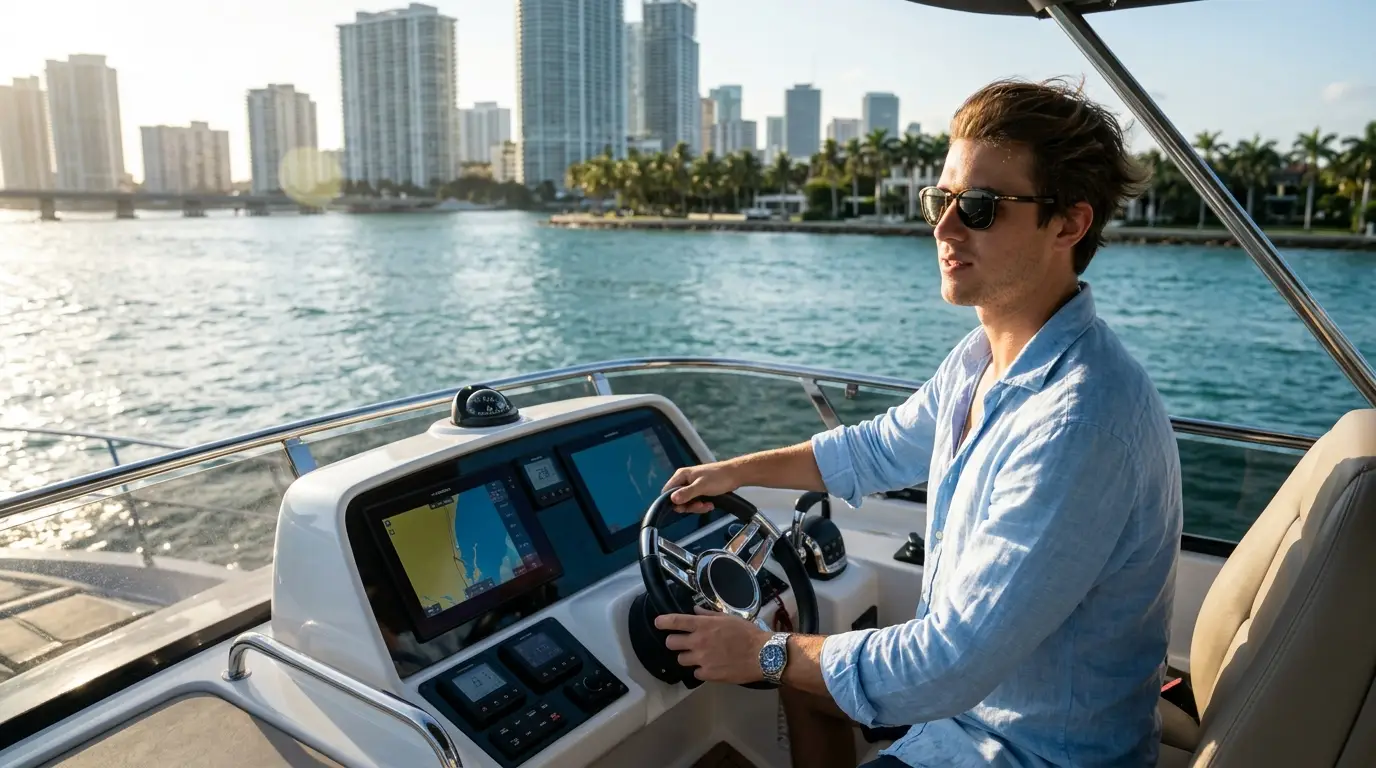
Stepping onto a private yacht in Miami for the first time is one of South Florida's hallmark activities. Gliding past the glass towers of Brickell, anchoring in waist-deep turquoise water at the Haulover Sandbar, and catching the sunset over Biscayne Bay are quintessential South Florida rituals.
However, if you have never rented a private boat before, the maritime logistics, legal regulations, and dockside pricing structures can feel confusing. Marketplace listing apps frequently advertise low headline rates that leave first-time charterers blindsided by separate captain fees, fuel charges, and dockside tips.
This guide breaks down exactly how private yacht rentals work in Miami, what laws protect your safety, how to budget an honest all-in total, and what to expect from the moment you book until you return to the marina slip.
1. Captained vs. Bareboat: Which Do You Need?
The first decision every charterer encounters is whether to book a captained charter or a bareboat rental.
For nearly all first-time charterers, you need a captained charter.
| Consideration | Captained Charter (Recommended) | Bareboat Charter (Self-Drive) |
|---|---|---|
| Experience Needed | None — sit back, relax, and enjoy | Extensive sea-time resume and navigational skills |
| Licensing | None required for guests | Florida Boating Safety ID (if born on/after Jan 1, 1988) |
| Legal Liability | Licensed USCG Master Mariner assumes responsibility | Charterer assumes 100% legal & maritime liability |
| Best For | Celebrations, family outings, relaxation | Experienced boat owners and commercial mariners |
Understanding the Differences
- Captained Charter: You hire a licensed US Coast Guard (USCG) Master Mariner to command the vessel. The captain handles navigation through busy tidal channels, docks the boat in swift currents, monitors marine radar for sudden squalls, and oversees safety gear. As the host, you and your guests simply relax, swim, and enjoy the day. You do not need a boating license, certification, or previous marine experience.
- Bareboat Rental (Driving Yourself): In a true bareboat charter, you lease the hull and take total legal responsibility for the vessel, navigation, and crew safety. Under Florida law, anyone born on or after January 1, 1988, must complete an approved boating safety course and carry a Florida Boating Safety Education ID card. Operating a twin-engine 40-foot motor yacht through Miami's crowded waterways and restricted no-wake zones requires significant maritime experience. If you do not own a yacht or have verifiable sea-time resume, do not attempt to self-drive a large vessel.
2. The 12-Passenger Rule: Federal USCG Law Explained
One of the most frequent surprises for first-time Miami charterers is the strict 12-passenger limit.
Under federal maritime law (46 U.S.C. § 2101), standard recreational charter vessels operate as Uninspected Passenger Vessels (UPVs). Federal law limits these vessels to a maximum of 12 paying passengers plus crew, regardless of how long the yacht is. Even if an 80-foot luxury motor yacht has deck seating for 30 people, carrying 13 or more paying guests on an uninspected hull is a federal violation.
Important Legal Fact: Every human being counts as a passenger toward the 12-person cap. Newborns, infants, and children legally count as full passengers under US Coast Guard regulations.
Legal Options for Groups of 13 or More
If your party has 13 or more guests, you have two legitimate options:
- Book a Coast Guard Inspected Vessel (COI): These are commercially inspected hulls certified to carry more than 12 passengers. In the Miami fleet on YATR there are exactly three: an 80ft sailing vessel (125 guests), a 100ft ship (140 guests) and a 222ft event vessel (600 guests).
- Tandem Multi-Boat Charter: Rent two separate boats that cruise to the same sandbar and anchor side-by-side (rafting up) for an afternoon swim.
If an operator on an uninspected recreational yacht offers to "squeeze in" 14 or 15 guests, decline immediately. The US Coast Guard actively patrols Biscayne Bay, and unlicensed or overloaded vessels are subject to immediate termination of voyage, leaving guests stranded at the nearest dock.
3. How All-In Pricing Really Works
When browsing online boat rental marketplaces, headline prices like "$150/hour" or "$300/hour" can be deeply misleading. Under bareboat demise charter rules, the boat rental is leased separately from captain services.
To avoid surprises, understand what a true charter invoice is made of:
Itemized Charter Cost Breakdown
| Cost Component | Typical 4-Hour Rate | How It Is Settled | Key Notes |
|---|---|---|---|
| A. Base Vessel Rental | From $2,477 (cheapest 4-hour listing) | Paid online upon booking | The boat's listed price for its stated duration |
| B. Captain & Crew Fee | $200 – $500 ($50–$125/hr) | Paid at dock or via booking app | Hired directly by charterer per demise rules |
| C. Fuel | Normally inside the base rate | Included for bay cruising | Long, fast open-ocean runs can cost extra, quoted by the operator |
| D. Booking Fees & Taxes | Shown at checkout | Paid online | If any apply, they appear on the payment screen before you pay |
| E. Crew Gratuity | 15% – 20% of base rate | Cash handed to captain | Customary South Florida maritime etiquette |
A. Base Vessel Rental
This is the charge for the yacht itself. From 110 active Miami charter listings checked in November 2026, listed prices by size are: $2,979 to $4,361 for 34–39ft boats (3 yachts), $2,477 to $4,236 for 40–49ft cruisers (12 yachts), $2,728 to $8,132 for 50–59ft motor yachts (16 yachts), $3,230 to $6,874 for 60–69ft yachts (20 yachts), $4,846 to $11,883 for 70–79ft yachts (19 yachts), and $4,468 to $34,502 for yachts of 80ft and over (40 yachts). Most of these prices are per 4 hours; a few yachts price per 6, 8 or 24 hours, and every listing states its own duration.
B. Captain & Crew Fees ($50 to $125 / hour)
On bareboat charter contracts, the captain is hired directly by the charterer. Miami dockside rates range between $50 and $125 per hour depending on boat size. For a standard 4-hour charter, plan for $200 to $500 paid directly to the captain (either via the booking platform or in cash at the dock).
C. Fuel Costs
Most Miami day charters cruise at idle speed through protected no-wake channels or sit anchored at a sandbar with generators running. At idle speeds fuel burn is low, and on YATR listings the boat's price normally covers this kind of cruising. The exception is a long, fast run in the open Atlantic: high-horsepower diesels burn far more fuel on plane, and the operator will quote that separately. If fuel matters to your budget, ask before you book, not at the dock.
D. Booking Fees & Taxes
Whether a tax or booking fee applies depends on how the charter is structured and which platform you book through. You do not need to work it out yourself: any such charge appears in the checkout total before you pay. If a total at checkout is higher than the listing price plus captain and gratuity, ask what the extra line is before you confirm.
E. Crew Gratuity (15% to 20%)
Tipping is standard maritime etiquette in South Florida. Similar to dining or hospitality services, customary gratuity is 15% to 20% of the base boat charter rate, handed in cash directly to the captain at the end of the trip to distribute among the crew.
4. Miami Marinas & Where You Will Depart
Where your charter departs significantly impacts how much cruising time you enjoy:
| Marina Name | Location | Primary Advantage | Best Cruising Routes |
|---|---|---|---|
| Miami Beach Marina | South Beach | Immediate deep-water ocean access; no drawbridges | Government Cut, Fisher Island, Downtown Skyline |
| Bayshore Landing & Dinner Key | Coconut Grove | Calm, sheltered waters; immediate southern bay access | Key Biscayne, Nixon Sandbar, Stiltsville |
| Sea Isle & Venetian Marina | Downtown Miami | Central city departures; spectacular skyline backdrop | Miami River, Star Island, Venetian Islands |
| Haulover Marina | North Miami | Closest point to northern sandbars; cuts transit time | Haulover Sandbar, Oleta River, Sunny Isles |
Key Marina Logistics
- Miami Beach Marina (South Beach): The main departure marina in South Florida. Located right at Government Cut, it offers immediate access to the open ocean, Fisher Island, and Biscayne Bay with no bridge openings required.
- Bayshore Landing & Dinner Key (Coconut Grove): Ideal for calm, scenic southern Biscayne Bay cruising, visits to Stiltsville, and anchorages near Key Biscayne.
- Sea Isle Marina & Venetian Marina (Downtown Miami): Positioned near the mouth of the Miami River, providing instant views of the Downtown Miami skyline and direct access to the Venetian Islands.
- Haulover Marina (North Miami): The closest departure point to the famous Haulover Sandbar. Starting here saves roughly 45 to 60 minutes of transit time along the Intracoastal Waterway.
5. What to Pack & Essential BYOB Rules
Most private Miami charters operate on a BYOB (Bring Your Own Beverage) and outside catering model without corkage fees. Reputable yachts provide large coolers, ice, and bottled water.
What to Bring:
- Towels: Most day charters do not supply bath or beach towels. Bring one per guest.
- Reef-Safe Sunscreen: Bring lotion rather than spray sunscreen. Aerosol spray sunscreen turns teak decks dangerously slick and leaves permanent orange stains on fiberglass gelcoat.
- Boat Shoes or Barefoot: Street shoes, dark-soled sneakers, and high heels are strictly forbidden on yachts. Expect to kick off your shoes into a dockside basket upon boarding.
- Cash for Captain's Tip: Keep cash in an envelope ready for the 15–20% gratuity upon return.
- Government Photo ID: The primary charterer must show valid photo identification matching the booking name.
What to Leave at Home:
- Red Wine & Dark Juices: Red wine stains white marine vinyl and porous teak instantly and is prohibited by virtually all boat owners.
- Glass Beer Bottles: Cans are safer and preferred on moving decks.
- Glitter, Confetti & Hookahs: Fire hazards and materials that damage bilge pumps are strictly barred.
6. Weather & Cancellation Policies
South Florida weather is tropical and dynamic. Summer and autumn months frequently see brief, intense 20-minute afternoon thunderstorms that pass quickly without disrupting an entire 4-hour charter.
- Captain's Discretion: The licensed USCG captain makes all final safety determinations. If a Small Craft Advisory, named tropical storm, or sustained lightning storm occurs during your scheduled window, reputable partner platforms permit rescheduling or issue refunds.
- Passing Rain: Charters do not cancel for light overcast skies or brief scattered showers. Modern motor yachts feature covered aft cockpits and air-conditioned interior salons where guests can relax comfortably until showers pass.
7. First-Timer Booking Checklist
To ensure your first Miami charter runs smoothly:
- Lock Your Guest Count First: Confirm whether you have 12 or fewer guests before selecting a boat class.
- Review the Line-Item Breakdown: Before confirming your booking, verify whether the captain fee is bundled or settled dockside, and read the checkout total line by line.
- Communicate Your Vibe to the Captain: Tell your captain upon boarding whether you want a high-energy sandbar party, a sightseeing architectural tour past celebrity mansions, or a quiet sunset drift.
- Book 2 to 4 Weeks in Advance: Prime Saturday and Sunday afternoon slots sell out weeks ahead during the November–May peak season.